Why corrugated cases need more than plain print
In South African distribution, corrugated cases are handled many times before they reach a shelf, clinic, cold room, or production line. Forklifts, hand stacking, shrink wrap, pallet bands, and rough municipal road transport all put pressure on outer packaging. That is why many converters and brand owners now add functional marks to the case itself, not just artwork on the face.
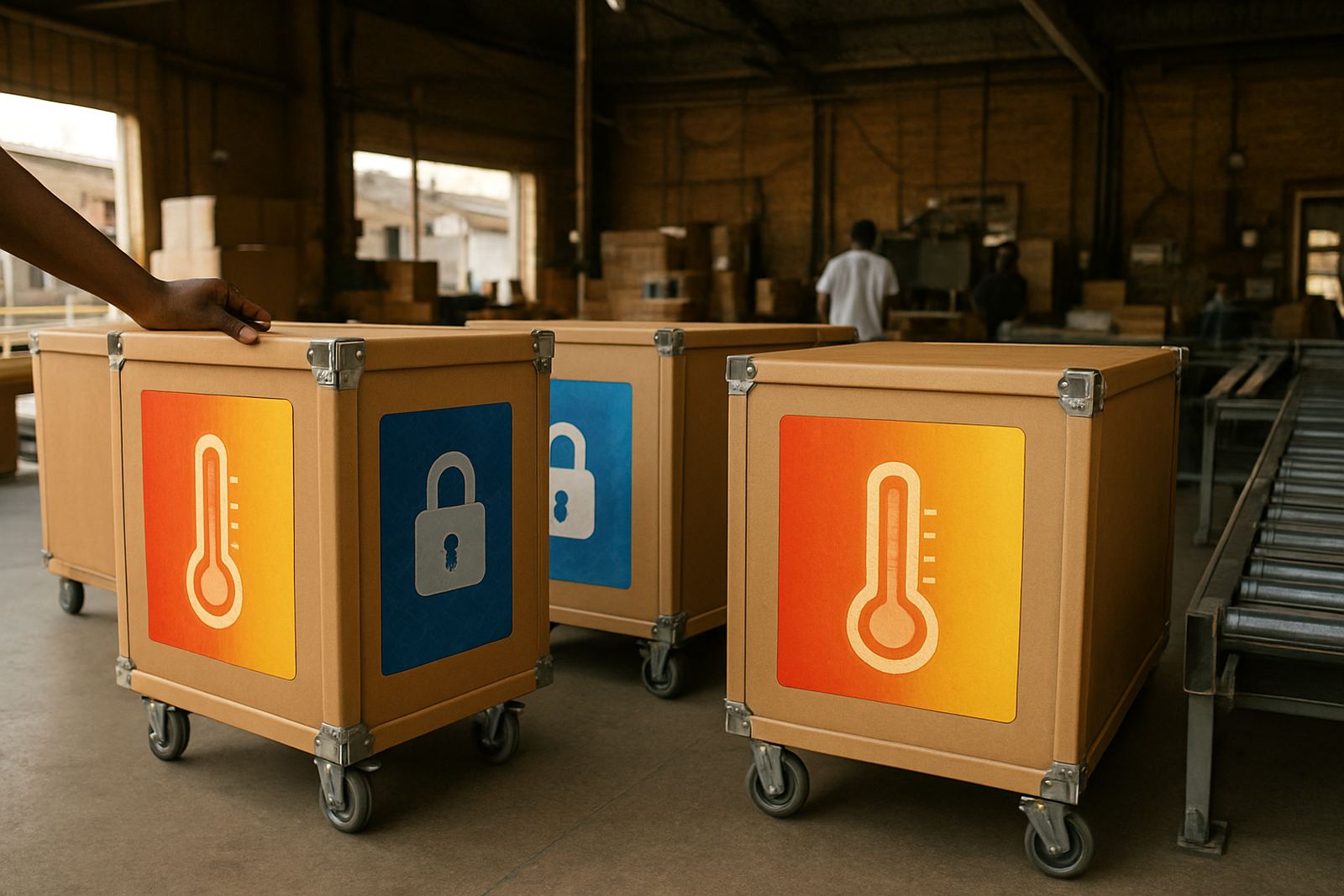
Thermochromic and security inks are useful on secondary cases because they give warehouse teams a quick visual check without opening the carton. A temperature mark can show whether a cold chain item has warmed above a set point, while a security mark can confirm authenticity or signal tampering. This is especially helpful for food ingredients, pharmaceutical cartons, cosmetics, and electronics accessories moving through Durban, Gauteng, the Cape and inland depots.
For corrugated board, the ink must suit the coating, flute structure, print process, and final packing method. A case that works well in dry inland conditions may behave differently in Durban humidity, so testing is not optional. We keep the focus on what will hold up in the real supply chain, not just on the press sheet.
Typical equipment and print setup for case work
Most corrugated case projects use flexographic or overprint application, though some converters also test screen or spot application for special marks. The choice depends on the line speed, the board grade, and how visible the cue must be after folding, gluing, and stacking. On large runs, the press team usually wants a simple layout with one or two control panels, so changeovers stay manageable.
For secondary packaging, a practical setup often includes the following:
- Corrugated board with a suitable top liner and consistent absorbency
- Drawdown panels for early colour checks before full production
- Trial batch making to confirm press behaviour at line speed
- Adhesion tests on printed and folded panels
- Rub resistance checks for pallet movement and warehouse handling
- UV verification setups for hidden or covert security elements
- Batch retain library samples for later comparison
It is also common to review coating compatibility if the case has a varnish, water-based overprint, or waxy finish. If the print layer sits on the wrong surface, the mark can look fine at first and then fail once the cartons are packed and strapped. That is a costly mistake, especially when a customer expects every case to carry the same signal.
How authentication marks help in warehouses and depots
Secondary cases can carry authentication marks for warehouse and distribution verification. In practice, that means a receiving team can scan the pallet visually, compare the printed feature against the retain sample, and separate any doubtful cartons before they move into stock. This helps with stock control, returns handling, and cross-border shipments where cases pass through more than one store room or yard.
Security features on corrugated cases do not need to be complicated to be useful. Many clients want a visible change, a hidden check, or a combination of both. We often advise a layout that puts the feature in a predictable position on the case panel, near the end flap or side panel, so staff do not waste time searching for it.
Where the product is temperature sensitive, the same carton can combine a colour change cue with a security element. That gives the logistics team one more layer of confidence before dispatch. It also helps in environments where load-shedding, warm loading bays, and long offload times can affect product condition. A well placed mark can make a big difference, even if the case itself looks ordinary from the outside.
Layout and planning advice for corrugated converters
Good planning starts with the end use. A case for coastal distribution in Durban does not behave the same as one stored in a dry Gauteng warehouse or moved through a hot truck in the Northern Cape. If the carton will be compressed, stacked high, or stored near moisture, the print area and ink load must be chosen with that in mind.
We normally advise clients to keep the functional mark away from glue lines, fold backs, and heavily scuffed edges. Leave enough flat space for the mark to be read after folding and taping, and keep the colour reference clear of busy artwork. If the case carries product data, a date code, and a security mark on the same panel, the layout must be planned so the message stays readable under warehouse lighting, not just on the pre press proof.
- Use a consistent print panel size across all case variants where possible
- Allow for board movement, especially on recycled corrugated grades
- Test at the same board moisture level used in normal production
- Confirm the mark still reads after glue, tape, and pallet wrap are applied
- Keep approval samples from each batch in a labelled retain library
Where production runs are short or seasonal, trial batch making is worth the time. It prevents repeat setup errors and gives the press team a reliable reference if the customer returns with a question later on.
Common mistakes we see on case projects
The biggest problem is treating a corrugated case like any other printed surface. Board is absorbent, variable, and affected by storage conditions. A formulation that works on a smoother substrate may spread too fast on corrugated stock or lose clarity after a rub test. Another common issue is placing the cue where handling will damage it first, which defeats the point of the feature.
We also see cases where the security mark is added but not properly verified under the real warehouse light source. If the check only works under perfect lab conditions, it will frustrate staff on the floor. That is why UV verification setups, press startup support, and production troubleshooting are all part of the conversation.
- Choosing the wrong board grade or coating
- Skipping adhesion tests before full run approval
- Ignoring rub resistance on stacked pallets
- Using too much ink and causing bleed on the liner
- Not training receiving staff on what the mark should look like
A simple, repeatable feature is usually better than an overcomplicated one. Warehouses want fast decisions, not a long inspection process.
Budget ranges for corrugated case projects
Budget depends on case size, ink type, security level, test work, and how many product codes need support. A basic colour cue for a single carton size may start from about R8 000 to R20 000 for development and trial work, then move into per case production pricing once the run is approved. More complex security patterns, multiple colours, or custom threshold tuning can push project spend to R25 000 to R60 000 and above, depending on the number of variants.
For larger packaging programmes, converters often budget separately for drawdown panels, trial batches, compatibility checks, and batch retain samples. That approach helps avoid surprise costs later if the client changes board spec, adhesive, or print sequence. It also makes national roll out easier when the same case must be produced in Jacobs, Pinetown, Prospecton, or sent to other centres like Cape Town, Gqeberha, Johannesburg, and Pretoria.
If your cartons are moving through high humidity, long warehouse stays, or mixed transport routes, factor in testing early. A small spend on validation can save a much larger loss from rejected stock, returns, or missed temperature checks.
Working with ThermoInk on case applications
Our Jacobs, Durban base supports packaging converters nationwide with colour matching, security pattern design, coating compatibility checks, and production troubleshooting. Sibusiso Mthembu leads the business, with Shaun October on technical sales, Lindokuhle Dlamini on production, Pieter van Wyk on security ink work, Nomfundo Khumalo in the colour lab, and Jason Pillay coordinating national logistics.
Clients usually come to us when they need a practical solution for a carton line that must do more than carry a label. We look at the board, the press, the handling method, and the verification step, then set up the ink system to fit that process. If the carton needs to prove authenticity in a depot or signal temperature exposure before dispatch, we can help shape the right control method and support the first production run.
Whether the job is for a cold chain supplier in Durban South or a converter sending cartons to inland depots, the aim stays the same: keep the case readable, consistent, and useful throughout the supply chain. That means fewer disputes, clearer checks, and better control over what leaves the factory.