When shrink sleeves need more than plain branding
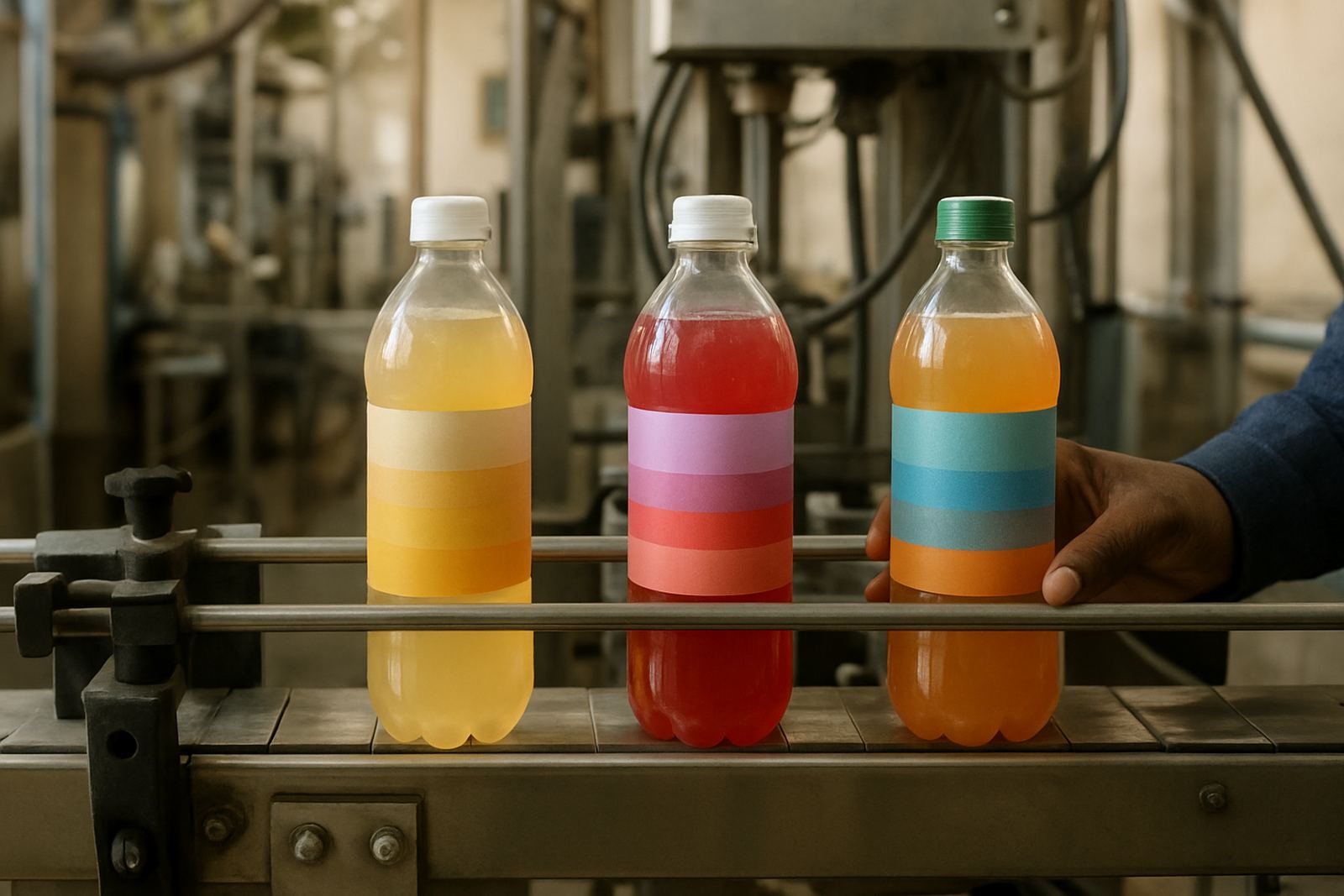
Shrink sleeves are often chosen when the pack needs full coverage, strong shelf appeal and a surface that can carry changing colour effects. In Durban, where humidity can move fast and trucks face coastal heat, the sleeve has to look good before and after shrinking, not only in the sample room.
ThermoInk works with packaging converters who supply beverages, personal care, sauces, household chemicals and temperature-sensitive goods. The common brief is simple: make the sleeve easy to read at speed, add a clear visual cue for heat or chill, and keep the print stable through handling, packing and distribution.
Typical equipment set on a shrink sleeve line
Most sleeve jobs run through print, slit, convert and heat-shrink stages, so the ink choice has to match the full production path. We look at the film type, the tunnel temperature, line speed and any post-print varnish or coating before approving a drawdown.
- Rotogravure or flexo print units for the base design and effect zones
- Slitting and cutting equipment for sleeve webs and seam areas
- Shrink tunnels using steam, hot air or a combination of both
- Heat seal or seam systems where the sleeve closes on pack
- Inspection lighting for UV checks, rub checks and colour shift review
If the converter is working from Pinetown, Prospecton or Jacobs, we can assist with trial batch making, threshold tuning and press startup support so the sleeve behaves properly on the actual line, not just in a sample print.
Planning the colour-change zones so they read on shelf
The best shrink sleeve effects are planned around where the shopper looks first. A colour-change band near the shoulder of the bottle, a warning panel near the cap, or a chill indicator around the front face can all work well if the artwork leaves enough breathing room. Tiny details often disappear once the film shrinks, so line weights and text sizes need proper allowance.
For good results, we usually advise teams to build the sleeve layout in layers: brand area, product information, security feature and the colour-change zone. That makes it easier to adjust one element without upsetting the rest.
- Keep the effect area away from folds, vertical seams and high distortion points
- Allow extra space around fine text and small icons
- Test where the sleeve lands on a curved bottle or contoured jar
- Confirm the effect still reads under store lighting and natural light
Security options for premium and sensitive packs
Shrink sleeves are useful for authentication because the full wrap gives more room for hidden or overt security features. For high-value packs, export goods or regulated products, we can design security patterns that support visual checking and production control.
That might include colour-shift zones, covert identifiers, batch marks or a repeat pattern that is hard to copy cleanly. We also help with batch retain library setup so the converter can keep reference samples for later comparison. In practice this saves time when there is a customer complaint, a tamper concern or a dispute over the print run.
Security ink work is usually paired with rub resistance checks and UV verification setups. If the sleeve will be handled a lot in warehouse packing, the inks should be checked before full release, not after pallets have already moved to Johannesburg or Cape Town.
Common mistakes that cost time and money
Most shrink sleeve problems start with a mismatch between the design and the way the pack behaves in heat. A design can look strong on paper then distort badly when it shrinks over ribs, corners or shoulder curves. Another common issue is setting the colour-change point too high or too low, so it activates at the wrong moment in the cold chain.
We also see trouble when the ink layer is not matched to the film or coating. Adhesion may look fine on day one then fail after transit, condensation or stacking pressure. A proper coating compatibility check avoids a lot of call-backs.
- Using artwork that ignores shrink direction and distortion
- Skipping press checks for rub resistance and heat response
- Choosing a trigger temperature that does not suit the product
- Not allowing for coastal humidity or warehouse temperature swings
- Leaving no retain samples for production comparison
Budget ranges for pilot runs and full production
Budget depends on the pack size, the number of colour-change zones, the type of security feature and how many trials are needed. A small pilot for one sleeve format may start from about R18 000 to R35 000 if the project needs drawdowns, threshold tuning and a trial batch. More involved runs with security pattern design, multiple tests and repeated press support can sit between R45 000 and R120 000.
For larger monthly production, the cost per sleeve usually drops once the setup is settled and the layout is locked. The safest approach is to price the first run as a development job, then revise after the converter has confirmed film behaviour, tunnel settings and print stability. That is where a local supply team helps because delays on a sleeve line can be expensive very quickly.
How ThermoInk supports converters nationwide
From our Jacobs base in Durban, ThermoInk supports packaging converters across South Africa, including Cape Town, Gqeberha, Johannesburg and Pretoria. Our team covers colour matching, adhesion tests, coating checks, production troubleshooting and press startup support, with deliveries arranged to site as needed.
Sibusiso Mthembu leads the business, with Shaun October handling technical sales, Lindokuhle Dlamini on production, Pieter van Wyk on security ink work, Nomfundo Khumalo leading the colour lab and Jason Pillay coordinating national logistics. Since 2008, the focus has stayed on practical print results that hold up in real packing conditions, not only in ideal trial room conditions.
For shrink sleeves, that means honest testing, clear planning and ink systems that suit South African pack lines from small trial runs to steady national supply.