Project brief for a retail sleeve range in Montague Gardens
The client was a packaging converter in Montague Gardens, Cape Town, handling a retail range that needed stronger shelf presence and a practical way to show temperature sensitivity. Their team wanted sleeves that would do two jobs at once: catch the eye on display, and give shoppers a simple visual signal when the pack contents were within the preferred temperature window.
The brief also included tamper-conscious presentation. The sleeves had to support product authenticity, keep the artwork readable after shrinking, and run properly on the existing sleeve line without slowing down production. We worked with their pack dimensions, label panels, and shrink tunnel settings from the start so the artwork and ink behaviour matched the actual packing process.
- Project type: Shrink sleeve for retail display
- Client type: Packaging converter serving FMCG and chilled goods
- Location: Montague Gardens, Cape Town
- Use case: Temperature cue and shelf impact
What made this sleeve run tricky
There were three main constraints. First, the sleeve needed to hold detail after application on curved containers, with no distortion around the shoulder and lower taper. Second, the colour-change feature had to trigger clearly enough for shoppers to notice, but not so quickly that it became distracting on the shelf. Third, the print had to maintain good adhesion and scuff resistance through handling, carton packing, and delivery into areas that can be humid near the coast.
Because the client’s supply chain included both local deliveries and out-of-town distribution, we also had to plan for a repeatable finish from batch to batch. That meant checking coating compatibility, confirming the shrink response on trial pieces, and reviewing rub resistance before final approval. In summer, Cape Town freight lanes and warehouse conditions can vary more than people expect, so we kept the production window tight and the spec stable.
- Heat response tuned for a clear on-pack change
- UV verification added for line-side checks
- Rub resistance checked after shrink application
- Adhesion tested on sample containers before release
Ink system, sleeve layout, and print controls
We supplied the thermochromic ink build, security ink elements, and the colour matching support needed to keep the sleeve artwork consistent across the run. Nomfundo Khumalo led the colour lab work, with Shaun October handling technical sales support and Pieter van Wyk advising on the security print elements. Lindokuhle Dlamini managed production checks, while Jason Pillay coordinated transport and timing for the converter’s receiving schedule.
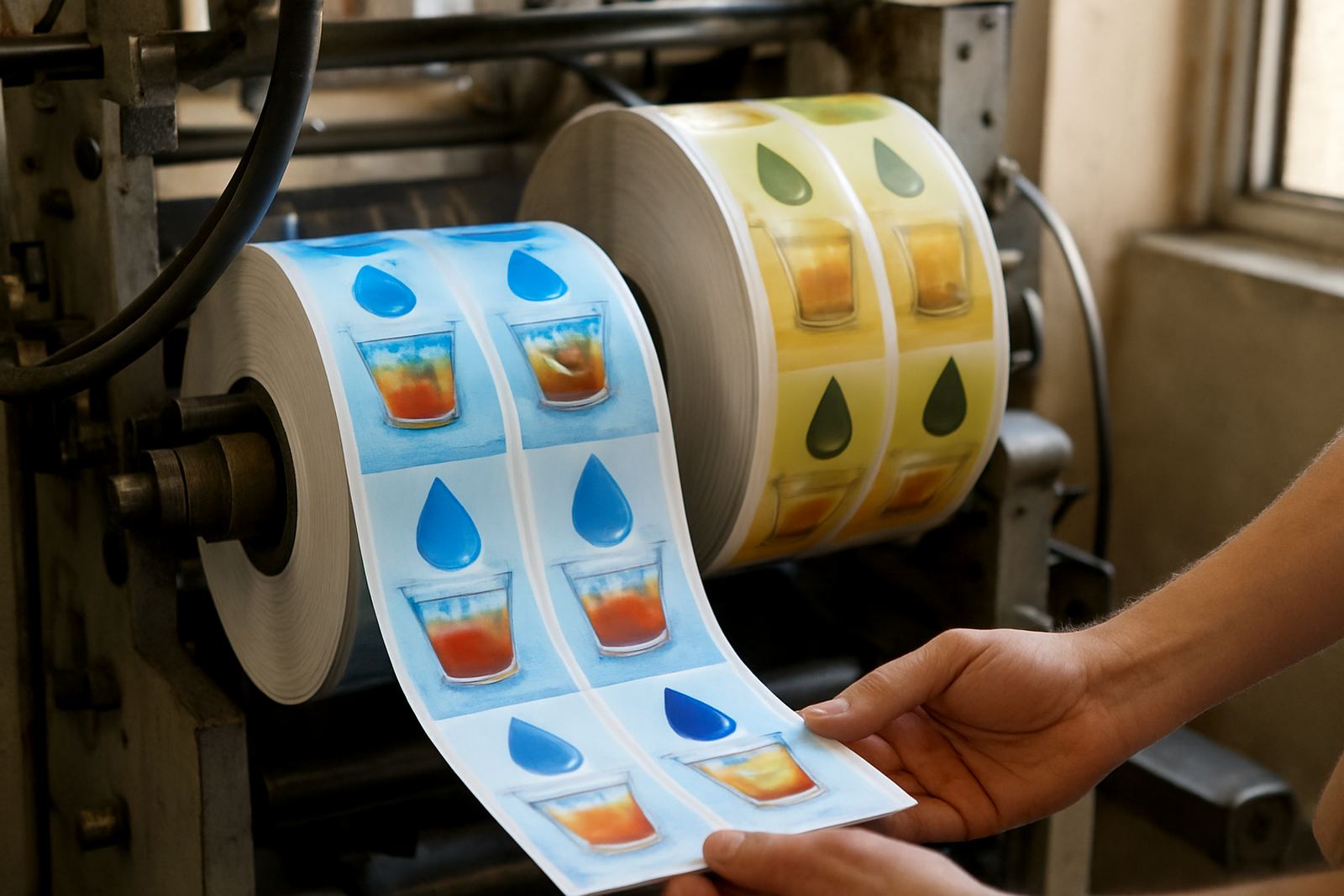
The sleeve artwork used a bold temperature graphic as the main visual cue, supported by a clean background and a high-contrast instruction panel. We adjusted threshold tuning so the colour shift was noticeable at the intended temperature point, not just under lab conditions. Security pattern design was integrated in a way that did not interfere with the retail front panel, which kept the pack looking clean while still adding an authenticity layer.
- Print build: Thermochromic ink plus security pattern layer
- Artwork focus: Large temperature graphic on front panel
- Checks included: Threshold tuning and UV verification setups
- Support task: Coating compatibility review before full run
Trial batch and press startup support
We started with drawdown panels and a small trial batch so the converter could confirm the sleeve behaviour before committing to full production. That let us test the ink on the actual substrate, confirm the colour change under working conditions, and check how the graphics looked after shrinking. The first pass showed one panel needed slightly more contrast at the lower temperature range, so we adjusted the formula and re-ran the test rather than forcing the spec.
Press startup support was handled on-site during the first production window. The client’s operators needed clear guidance on dwell times, registration checks, and how the sleeves would behave if line speed changed during the run. We also kept a batch retain library so the approved reference could be compared later if the client needed a repeat order. That saved time when sign-off had to move fast.
- Trial batch made and approved before full production
- Press startup support given during the first run
- Batch retain library set up for repeat orders
- Production troubleshooting logged for future runs
Timeline, delivery, and practical outcome
The full project ran over four weeks from brief to final sign-off. Week one covered artwork review and pack measurements. Week two was drawdowns and compatibility checks. Week three was the trial batch, threshold tuning, and application testing. Week four covered the production run, packing, and dispatch into the client’s distribution stream.
The result was a sleeve that did what the client needed on shelf and on line. The temperature graphics drew attention in retail display, while the security features gave the converter a stronger authenticity story for their customer. The pack kept a neat finish after shrinking, and the client was pleased that the print held up through handling and delivery without visible scuffing. That matters when product needs to look right in store, not just when it leaves the factory.
- Timeline: 4 weeks end to end
- Outcome: Strong shelf impact with reliable application
- Distribution: Delivered into the converter’s nationwide supply chain
What we would repeat on the next sleeve job
If we were doing this project again, we would keep the same process structure. Early drawdowns, a short trial batch, and on-line support are still the best way to avoid surprises on a shrink sleeve project. For temperature-sensitive packaging, the key is to tune the ink to the actual process, not just a sample panel under ideal conditions.
We would also keep the security feature discreet but present, especially for retail packs where the front face has to stay clean. For converters in Durban, Cape Town, Johannesburg, or anywhere else in South Africa, the practical approach is the same: match the ink to the substrate, test the shrink, and verify the finish before the run goes live.
- Repeat the same trial-first process
- Keep security features visible only where needed
- Recheck colour and rub resistance before each repeat batch
Key facts
| Project | Shrink sleeve for retail packaging |
|---|---|
| Client location | Montague Gardens, Cape Town |
| Timeline | 4 weeks |
| Core features | Thermochromic ink, security pattern, UV verification |
| Testing | Drawdowns, adhesion tests, rub resistance checks |
| Support | Colour matching, threshold tuning, press startup support |