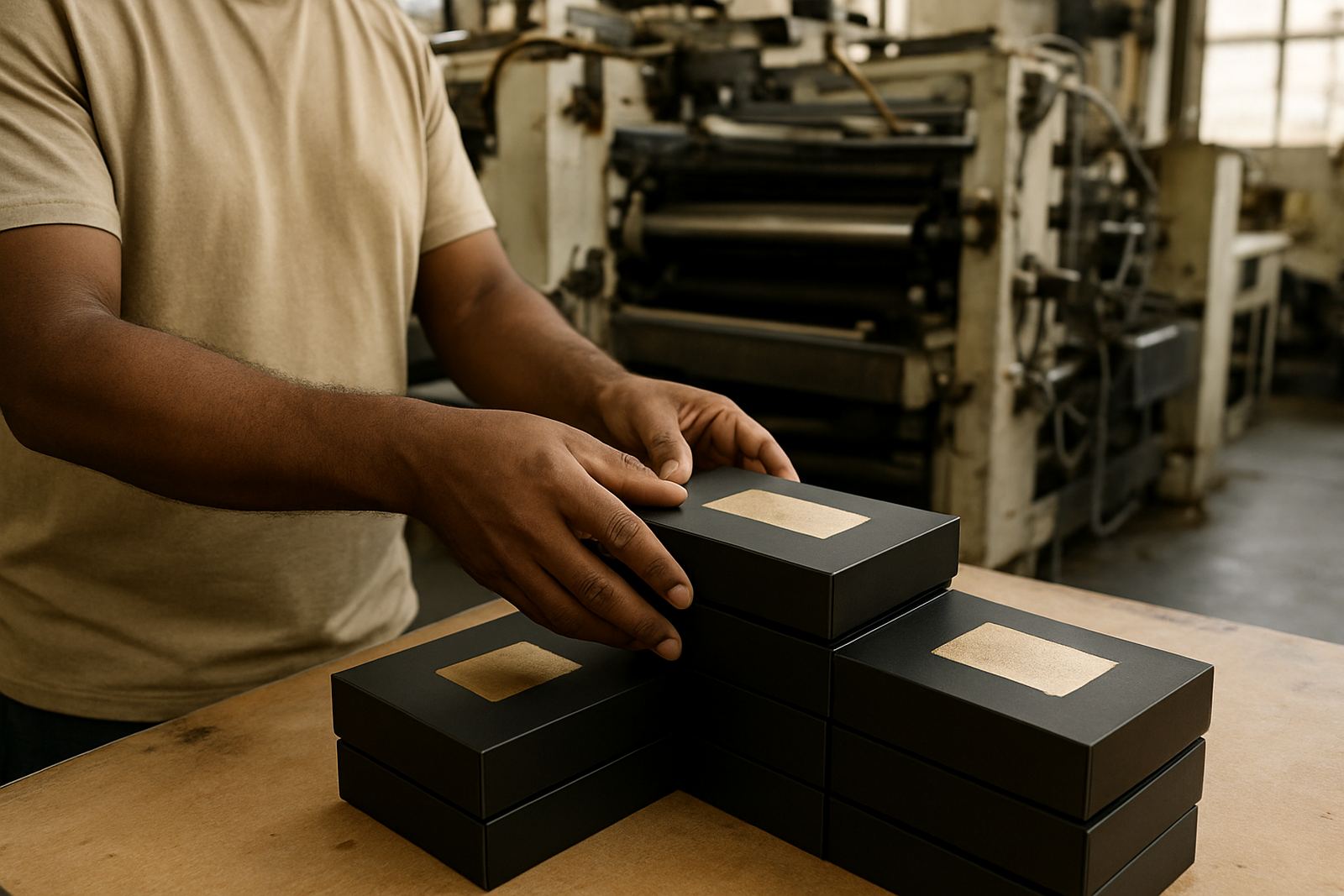
When a tamper seal has to do more than close a carton
For many South African packers, a seal is not just a closing point. It is part of the proof that the product has stayed intact from the line to the shelf. That matters on food packs, health products, export cartons, refill packs and any item where a broken seal can trigger a return, a complaint, or a quality hold. In humid coastal conditions around Durban, and in hot warehouse spaces inland, the seal also has to keep its print legible after stacking, transport, and handling.
Security inks can be used so the seal changes appearance if it is lifted, stretched, heated, or tampered with. That gives the user a clear visual cue without relying only on a foil strip or adhesive line. For converters, this is useful when the pack design must stay simple but still carry an anti-tamper feature that the end user can check at a glance.
Typical seal builds used on local packing lines
A good result starts with the full pack structure, not just the ink. We look at the substrate, seal size, application method, drying time, and how the carton or label moves through the line. In practice, the setup may include printed seal stock, a coated area for security ink, a clear overprint for protection, and a final adhesive or heat seal that gives the pack its closure.
On smaller runs, a converter may test the seal on flat sheets or pre-cut labels before moving to press trials. On higher volume work, the focus shifts to how the seal behaves during folding, carton gluing, and case packing. If the ink is too sensitive, it can mark during transit. If it is too hard, the tamper signal may not show up clearly enough. That balance is usually set through threshold tuning and drawdown panels before full production.
- Paperboard seals for cartons and sleeves
- Film labels for jars, tubs, and pouch closures
- Void or colour-change seal areas for opening evidence
- Security pattern zones that support brand checking
Planning the seal layout before print starts
Layout planning should start with where the customer will first touch the pack. If the opening point sits on a side flap, the warning or colour change must land exactly there. If the seal crosses a closure seam, the design needs enough coverage to break cleanly when the pack is opened. Good planning also allows for registration tolerance, since many local lines run with small shifts during startup and after changeovers.
Our team in Jacobs often advises converters to keep the tamper message simple and easy to read. Small text can get lost once the ink changes state, especially on textured board or rough kraft material. In areas with load-shedding, it helps to plan for repeatable drying and to avoid a design that depends on a very tight process window. If the line pauses, the ink still has to cure properly and hold its function when production resumes.
- Allow for seam movement of 1 to 3 mm on hand-applied packs
- Keep key warning marks away from glue squeeze-out
- Test both open and closed states under warehouse light
- Check compatibility with varnish, adhesive and film lamination
Checks that catch the common mistakes early
Most tamper seal problems come from process mismatch, not the concept itself. A seal may look fine on press but fail after stacking, rubbing, or exposure to heat in transit. On coastal routes, moisture can affect adhesion. On inland routes, high day-time temperatures can soften some coatings and change how the seal behaves under pressure. That is why we do rub resistance checks, adhesion tests, and UV verification setups before release.
Another common mistake is building the security feature too close to the edge of the seal. That can cause partial breakage without a clear signal. It is also common to use a colour that looks strong on screen but reads poorly on the actual substrate. Our colour lab team checks that the shift is obvious on real stock, not just in theory. For production teams, trial batch making and batch retain library records help when a problem needs to be compared later on.
- Do not rely on one print test only, especially on new board grades
- Do not place the signal where tape or glue can hide it
- Do not skip handling tests after cutting and packing
- Do not approve artwork before the line sample is checked under actual light
What equipment and line support you usually need
Most seal projects do not need a full equipment change, but they do need the right controls around the print process. A typical set-up includes a print unit or coating station, test panels for approval, a drying or curing stage, and a packing line that can hold the seal position accurately. Where security features are used, the converter may also need viewing tools for UV verification or simple inspection aids at line side.
ThermoInk supports these jobs with press startup support, production troubleshooting, coating compatibility checks, and security pattern design. If the packer is switching between product sizes, we also look at how the seal is stored, cut, and applied. Jason in logistics can coordinate supply into Durban, Pinetown, Prospecton, Cape Town, Gqeberha, Johannesburg and Pretoria so trial material and repeat orders get to site without avoidable delays.
Budget ranges for tamper seals in Rand
Budget depends on the seal size, the number of colours, the level of security required, and whether the work is for a short trial or a recurring production run. For a small development batch, customers often budget from about R8,500 to R18,000 for setup, testing and initial material handling. Mid-size repeat work can move into the R25,000 to R60,000 range once artwork checks, trial batch making, and approval samples are included. Larger recurring programmes with several pack sizes and strict verification steps can run higher, especially if there are multiple substrates or export requirements.
It is usually cheaper to get the seal structure right at the start than to fix a failure after product has left the warehouse. A false pass on tamper integrity can create returns, relabelling, or rework that costs more than the original print. For that reason, many converters ask for a retain sample library and a planned test pack before going to full run.
Clients in Jacobs and across the country can reach us through the enquiry form on our contact page to discuss practical pricing for a specific pack and line speed. We work with packaging converters nationwide, from first sample to production support.